

Working with your body
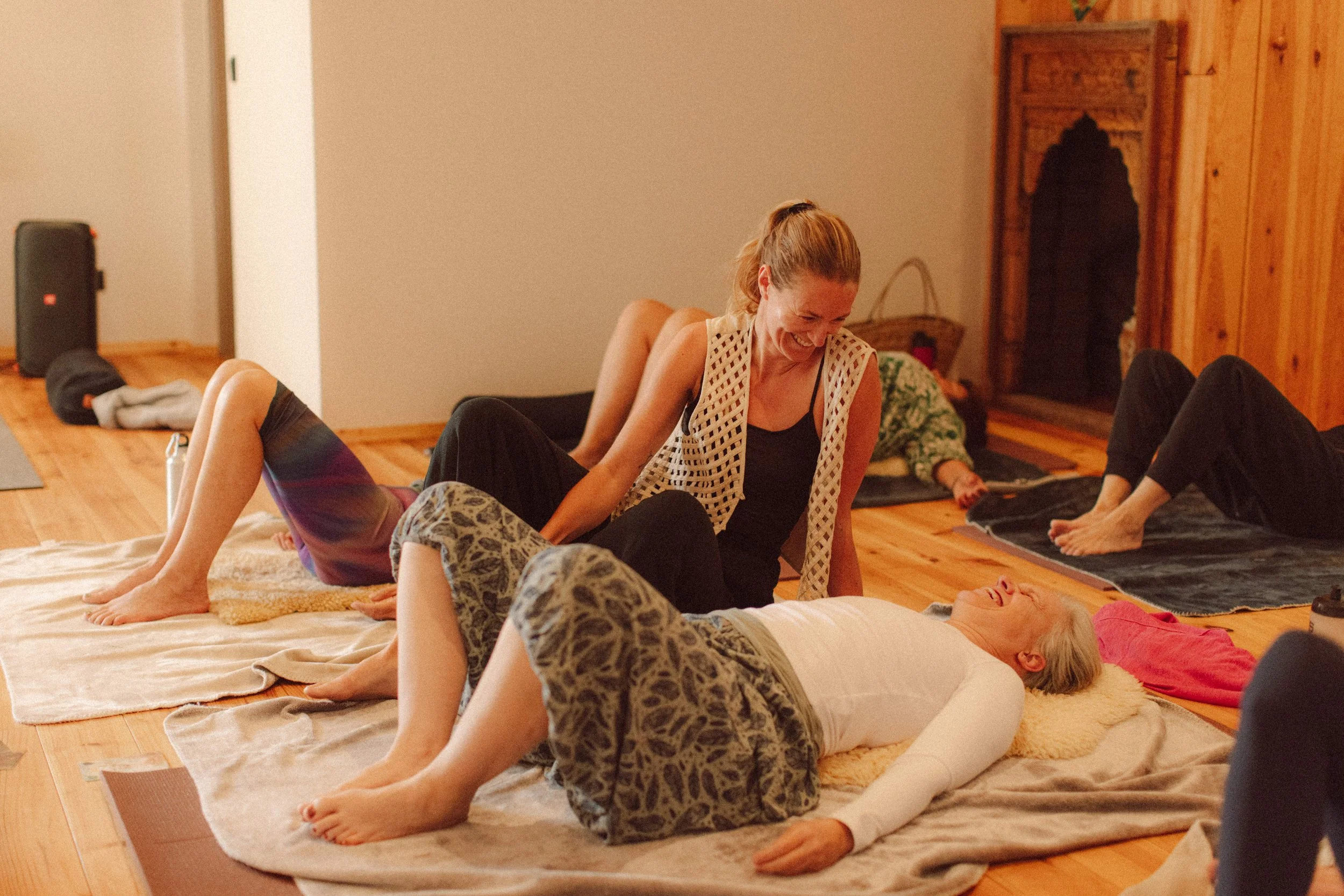
We honour the innate wisdom of your body as a powerful tool for healing. Through practices such as yoga, T.R.E. (Tension & Trauma Release Exercises), dance, somatic experiencing, breathwork, and mindful movement, you’ll be guided to reconnect with yourself. These practices can help unwind patterns of tension and protection, regulate the nervous system, and support a greater sense of safety, connection, and ease.
What do we mean by “somatics”?
Somatics is the practice of tuning into the body from the inside out. Rather than focusing on how a movement looks, somatics is about how it feels. It helps you reconnect with your body’s natural wisdom and become more aware of sensation, emotion, tension, breath, and nervous system responses.
By slowing down and paying attention to what is happening within, somatic practices can support nervous system regulation, reduce stress, restore flexibility, and create lasting change in both body and mind.
Top-Down vs Bottom-Up Healing
There are two main approaches to healing: top-down and bottom-up. When we experience stress or trauma, the mind and body often respond in different ways.
Top-down approaches, such as talk therapies, help us tell the story, understand what happened, and gain insight and clarity. Yet many people find that even after years of understanding things intellectually, their nervous system can still respond as though the past is somehow still present through anxiety, tension, hypervigilance, shutdown, or disconnection.
This is where somatic, bottom-up work can become so valuable. By focusing directly on the body’s sensations, rhythms, breath, and patterns of activation, these approaches help create the conditions for greater regulation, safety, and flexibility within the nervous system.
Through movement, breath, tremors, stillness, or simply awareness, the body is supported to move out of habitual survival responses and reconnect with a sense of presence, calm, and aliveness.
A top-down approach begins with the mind:
Through talking, thinking, and understanding, it creates change by making sense of our experiences. This can be beneficial, but it’s only part of the picture. On its own, a top-down approach doesn’t always reach the deeper physiological patterns through which stress and trauma can continue to shape how we feel, respond, and relate to ourselves and others.
A bottom-up approach starts with the body:
Rather than trying to think our way into healing, it uses sensation, movement, breath, and nervous system regulation to restore balance. By helping the body feel safer and more regulated first, the mind often naturally follows, allowing old patterns of tension, protection, and disconnection to lessen over time.
“Somatic therapies posit that our body holds and expresses experiences and emotions, and traumatic events or unresolved emotional issues can become 'trapped' inside"
Amanda Baker, director of the Center for Anxiety and Traumatic Stress Disorders
“Talking can be an important part of healing, but you as a whole organism do not truly change until your body comes to life and comes out of danger mode.” - Peter Levine
Your Nervous System
Your nervous system is designed to keep you safe. It helps you respond to challenges by moving into survival responses such as fight, flight, or freeze and, once the danger has passed, naturally guides you back towards balance. In a healthy cycle, the body releases the charge of stress—sometimes through shaking, movement, tears, or deep rest—and settles once again into a state of calm.
In modern life, however, many of us rarely complete this cycle. The ongoing pressures of work, family, finances, screens, and overstimulation can keep us switched "on" for long periods of time. Instead of fully releasing stress, we carry it within the body, leaving the nervous system stuck in a state of protection or survival.
Over time, this can contribute to anxiety, poor sleep, digestive issues, chronic pain, fatigue, menstrual and fertility challenges, emotional reactivity, or a sense of disconnection from ourselves and others.
Somatic practices help gently unwind these patterns. By slowing down, finding safety, tuning into sensation, and allowing the body to soften, move, breathe, and rest, the nervous system can rediscover its natural capacity for regulation, resilience, and connection.
Our Emphasis on Somatic Approaches
Our approach is inspired by the work of trauma expert Bessel van der Kolk. In his influential book The Body Keeps the Score, he explores how difficult life experiences can continue to shape our emotions, relationships, and sense of wellbeing long after they have passed.
Trauma is not only held in our memories and thoughts; it can also be reflected in patterns of tension, overwhelm, reactivity, or disconnection within the body and nervous system. This helps explain why we can understand our experiences intellectually and still find ourselves struggling with anxiety, emotional triggers, or a sense of disconnection in everyday life.
Van der Kolk's work highlights the importance of engaging the body in healing, not just the thinking mind. Through movement, breath, rest, mindful awareness, and other somatic practices, we can begin to reconnect with ourselves, cultivate a greater sense of safety and presence, and support the body's innate capacity for healing and restoration.
Before, during, and after our retreats, this embodied approach forms an important part of the journey, supporting women to reconnect with themselves in ways that are compassionate, grounded, and nourishing.